
Robotics
Physics Guards for Residual Policies at Breakaway
When learned corrections should defer to a friction model
Clement Nana Aidoo
30% → 2%
Overshoot in sliding at r = 1.2, with a residual trained under the shield (MuJoCo, 40 test objects)
Summary
A learned residual on top of a physics controller makes its worst errors at breakaway, when friction drops from static to kinetic. We derive two breakaway shields, one for gravitational pivoting and one for controlled sliding, and test them in a pre-registered MuJoCo study with emulated stick–slip.
Our summary. The archived abstract is the authority: doi:10.5281/zenodo.23503813.
What it found
- F1
In sliding, a residual trained under the shield cut overshoot from 30% to 2% at r = 1.2 and ended within 5 mm on 96–98% of episodes.
- F2
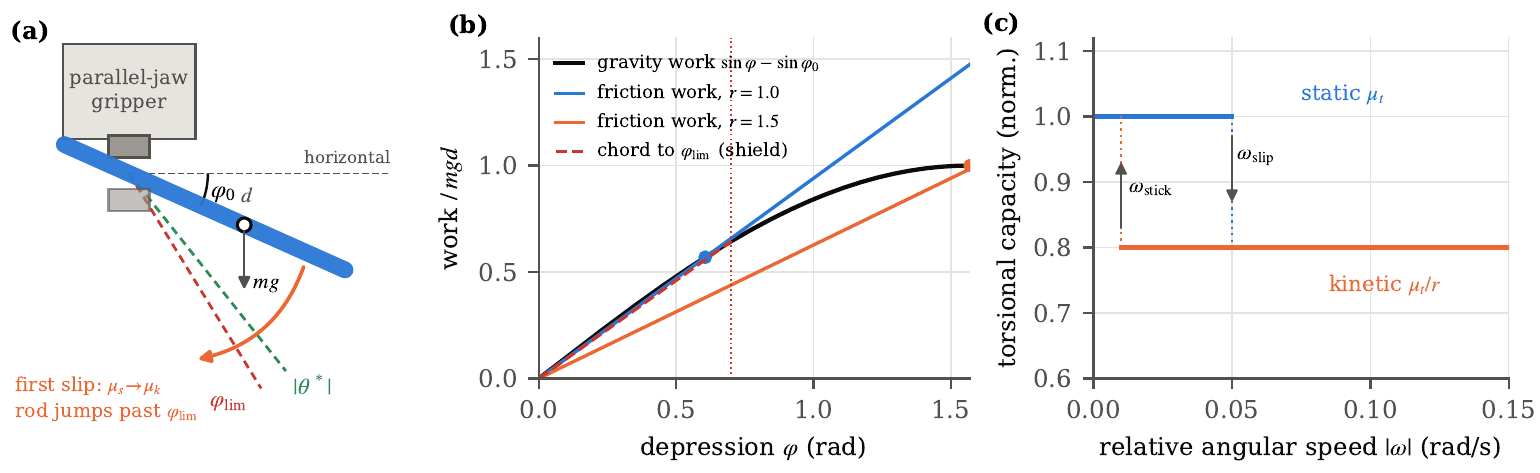
In pivoting, a certified release from rest exists only if r < φlim / sin φlim, so shallow targets are infeasible for realistic r. The shield found no certified release for exactly half of the test targets.
- F3
Deferring to the model in those cases left overshoot at 63% at r = 1.1. Declining prevented overshoot, but only by stopping short.
Limitations
- Simulation only: MuJoCo with emulated stick–slip.
- Within the assumed range, certificates were violated on at most 0.5% of steps, mostly through soft-contact effects of the simulator.
- In sliding, the shielded residual kept only part of the unshielded residual’s measurement saving.
Cite
@misc{aidoo2026physicsguards,
  title  = {Physics Guards for Residual Policies at Breakaway: When Learned Corrections Should Defer to a Friction Model},
  author = {Aidoo, Clement Nana},
  year   = {2026},
  note   = {Submitted to engrXiv},
  doi    = {10.5281/zenodo.23503813},
  url    = {https://doi.org/10.5281/zenodo.23503813}
}Evidence chain
01 · Claim
30% → 2%
02 · Figure
03 · Code
04 · Archive
Code and data